
Computer networks form the backbone of modern communication, enabling everything from email and cloud computing to streaming and global financial transactions. Over time, network designs have evolved significantly in structure, scale, and standards. This article explores network topologies, network types, major standards, and how these elements have transformed from early implementations to today’s high-speed, software-defined environments.
1. Network Topologies
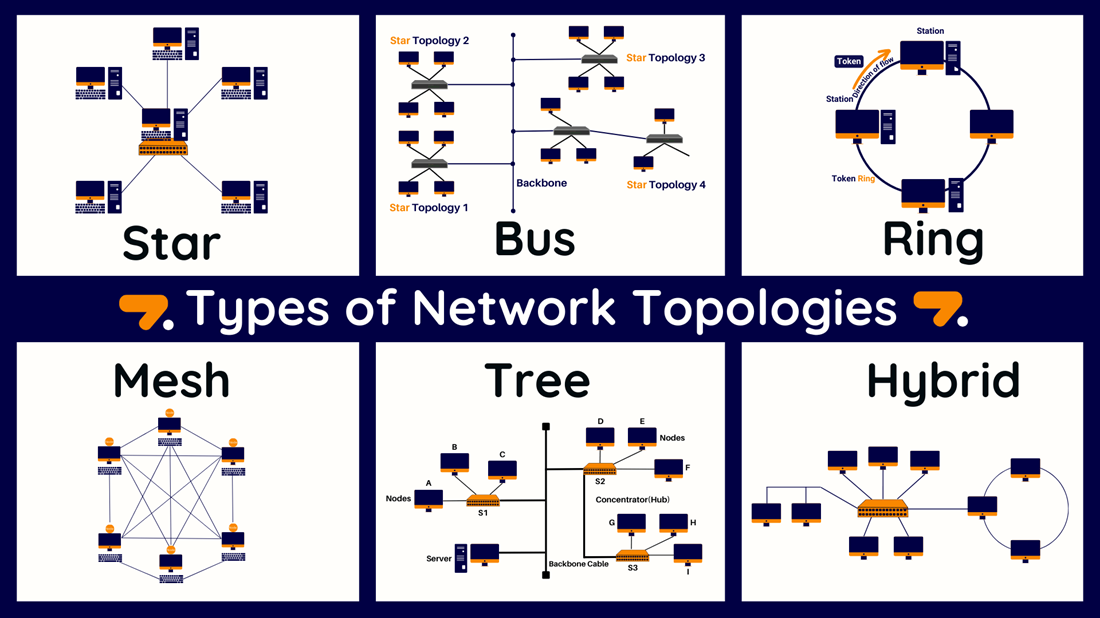
A network topology refers to the physical or logical arrangement of devices (nodes) and connections in a network. Topology affects performance, scalability, reliability, and cost.
Bus Topology
In a bus topology, all devices connect to a single shared communication line (the bus). Early Ethernet networks based on IEEE 802.3 commonly used this structure, particularly 10BASE2 and 10BASE5 implementations.
Advantages:
- Low cost
- Simple to implement
Disadvantages:
- Single point of failure (the main cable)
- Limited scalability
- Performance degrades with traffic
Bus topology was common in the 1980s but has largely disappeared in modern enterprise networks.
Star Topology
In a star topology, each device connects to a central device such as a hub or switch.
Advantages:
- Easy to manage and expand
- Failure of one cable doesn’t affect others
- Better performance with switches
Disadvantages:
- Central device is a single point of failure
Today, star topology is the dominant physical design in Local Area Networks (LANs), particularly with Ethernet switches.
Ring Topology
In a ring topology, devices connect in a circular pattern, and data travels in one direction (or sometimes both).
A well-known example is Token Ring, developed by IBM.
Advantages:
- Predictable performance
- Reduced collision issues
Disadvantages:
- Breaks in the ring can disrupt the network
- Complex troubleshooting
Ring networks were popular in enterprise settings in the 1980s and 1990s but have mostly been replaced by switched Ethernet.
Mesh Topology
In a mesh topology, devices interconnect with multiple redundant links. Mesh can be:
- Full mesh (every node connected to every other node)
- Partial mesh (some nodes have multiple connections)
Advantages:
- High reliability and redundancy
- Fault tolerance
Disadvantages:
- Expensive and complex
Mesh topologies are common in Wide Area Networks (WANs), data centers, and wireless mesh systems.
Hybrid Topology
Modern networks often combine multiple topologies, forming hybrid topologies. For example, a large organization may use star topology within offices but mesh connections between core routers.
2. Types of Networks
Network types are categorized based on size, geographic scope, and function.
Local Area Network (LAN)
A LAN connects devices within a limited area, such as a home, office, or campus. Most LANs use Ethernet under IEEE 802.3 or wireless standards under IEEE 802.11.
LANs evolved from coaxial cable bus systems to modern switched Gigabit and 10-Gigabit Ethernet networks.
Wide Area Network (WAN)
A WAN spans large geographic areas, connecting multiple LANs. The most prominent WAN is the TCP/IP.
WAN technologies have evolved from leased lines and frame relay to MPLS and software-defined WAN (SD-WAN).
Metropolitan Area Network (MAN)
A MAN covers a city or large campus. Often implemented using fiber-optic infrastructure, MANs are used by ISPs and large institutions.
Personal Area Network (PAN)
A PAN connects devices within a short range (e.g., Bluetooth devices). PANs support wearable devices, smartphones, and IoT connectivity.
Storage Area Network (SAN)
A SAN provides high-speed network access to storage devices. SANs use technologies like Fibre Channel and iSCSI and are common in enterprise data centers.
3. Networking Standards and Protocols
Networking standards ensure interoperability between devices from different manufacturers.
Ethernet (IEEE 802.3)
IEEE 802.3 defines wired Ethernet. Since its creation in the 1980s, Ethernet speeds have increased dramatically:
- 10 Mbps (10BASE-T)
- 100 Mbps (Fast Ethernet)
- 1 Gbps (Gigabit Ethernet)
- 10 Gbps and beyond
Ethernet evolved from shared hubs (collision-prone) to switched full-duplex networks, eliminating most collisions.
Wi-Fi (IEEE 802.11)
IEEE 802.11 governs wireless LAN technology. Key milestones include:
- 802.11b (11 Mbps)
- 802.11g (54 Mbps)
- 802.11n (MIMO technology)
- 802.11ac and 802.11ax (Wi-Fi 6)
Wireless networking transformed mobility and enabled IoT ecosystems.
TCP/IP
TCP/IP is the foundational protocol suite of the Internet. It includes:
- IP (Internet Protocol)
- TCP (Transmission Control Protocol)
- UDP (User Datagram Protocol)
TCP/IP replaced older proprietary networking protocols and enabled global internetworking.
Token Ring (IEEE 802.5)
Token Ring used token-passing to control access to the medium. Although largely obsolete today, it was significant in enterprise networking history.
4. Evolution of Network Topologies
Early Networks (1970s–1980s)
Early LANs were simple and often used bus or ring topologies. Coaxial cable Ethernet and Token Ring were common. Networks were small, localized, and primarily used for file sharing and printing.
Rise of Switched Ethernet (1990s)
The introduction of Ethernet switches transformed networks from shared media (hubs) to dedicated point-to-point links. Star topology became dominant, improving performance and reliability.
During this period:
- TCP/IP became universal
- The Internet expanded globally
- Client-server architecture replaced peer-to-peer dominance
Broadband and Wireless Era (2000s)
Fiber optics, DSL, and cable broadband expanded WAN access. Wi-Fi adoption surged under IEEE 802.11, making wireless LANs standard in homes and enterprises.
Topologies became more hierarchical:
- Access layer
- Distribution layer
- Core layer
Cloud and Virtualization (2010s)
Data center networking evolved to support virtualization and cloud computing. Mesh and leaf-spine topologies emerged for high-performance east-west traffic.
Software-Defined Networking (SDN) introduced programmable network control, decoupling hardware from control logic.
Modern Networks (2020s–Present)
Today’s networks emphasize:
- High-speed fiber (40G, 100G, 400G Ethernet)
- Wireless mobility (Wi-Fi 6 and 6E)
- SD-WAN
- Zero-trust security models
- IoT integration
- Edge computing
Topologies are often logical rather than purely physical. Overlay networks and virtual LANs (VLANs) abstract physical connections.