
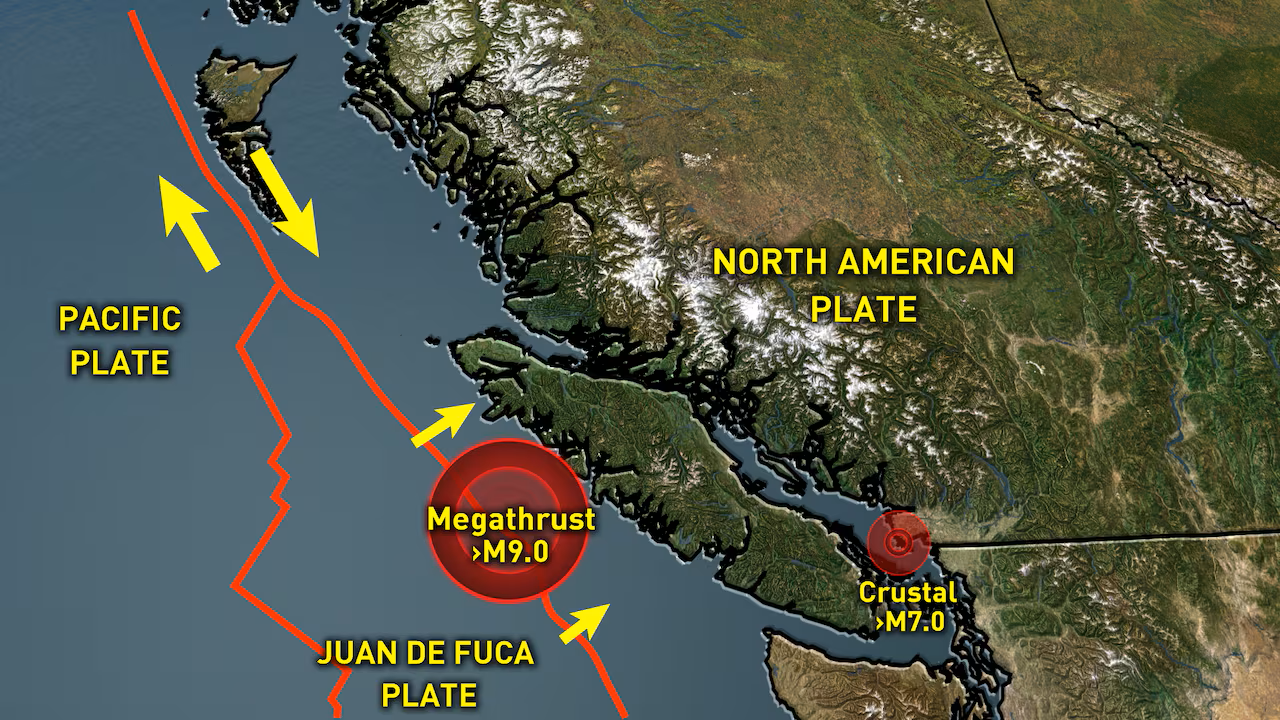
In recent years, geo-scientists have made a remarkable discovery beneath the Pacific Ocean off the coast of Vancouver Island, Canada. Using advanced seismic imaging and oceanographic surveys, researchers have identified a massive tear forming in an oceanic tectonic plate within the Cascadia Subduction Zone.
This finding offers a rare glimpse into the internal mechanics of Earth’s crust and could reshape scientific understanding of how tectonic plates evolve, fragment, and eventually disappear. The discovery also has important implications for earthquake research across the Pacific Northwest.
A Rare Glimpse Beneath the Pacific
The region off Vancouver Island is one of the most geologically active places in North America. It lies along the boundary where the Juan de Fuca Plate and the Explorer Plate slide beneath the North American Plate in a process known as subduction. This boundary forms part of the larger Cascadia Subduction Zone, a 1,000-kilometer-long fault system stretching from northern California to British Columbia.
In subduction zones, dense oceanic plates sink beneath lighter continental plates, slowly recycling Earth’s crust back into the mantle. This process drives many of the planet’s largest earthquakes and volcanic systems. For decades, scientists believed this tectonic system behaved relatively consistently along its length. However, new data from ocean-bottom seismometers and high-resolution imaging technologies reveal that the northern end of the system is undergoing something far more dramatic: the plate itself is tearing apart.
Researchers now believe the oceanic crust beneath northern Cascadia is splitting into fragments rather than moving as a single solid slab.
The Discovery of the Tectonic Tear
The breakthrough came during a large scientific expedition known as the Cascadia Seismic Imaging Experiment. During this project, researchers towed long arrays of underwater sensors behind a research vessel and sent acoustic signals into the seafloor. By analyzing how the signals bounced back, scientists produced detailed images of rock structures miles beneath the ocean floor.
These images revealed a deep fracture running through the descending tectonic plate near northern Vancouver Island. The tear lies near the Nootka Fault, a complex boundary where multiple tectonic plates intersect.
According to the study, the rip extends roughly 35 kilometers (about 22 miles) along the plate boundary and slices down to depths of approximately 40 kilometers (around 25 miles) beneath the seafloor.
Rather than breaking instantly, the plate appears to be slowly tearing apart over millions of years.
Geologists describe the process as similar to a piece of fabric gradually splitting under tension. The result is that portions of the oceanic plate are peeling away and forming smaller fragments called microplates.
This is the first time scientists have directly observed a subduction zone breaking apart in real time.
Understanding a “Dying” Subduction Zone
Subduction zones are among the most powerful geological systems on Earth, but they do not last forever.
Over millions of years, tectonic plates are consumed by the mantle, new boundaries form, and old ones disappear. Scientists previously suspected that subduction zones eventually break down, but direct evidence had been scarce.
The discovery off Vancouver Island appears to show exactly how this happens.
Instead of shutting down abruptly, the subduction system gradually disintegrates. Sections of the oceanic plate begin tearing into pieces, creating new faults and boundaries as they fragment. Eventually, the process could stop subduction entirely in that region.
Researchers have described this phenomenon as watching a tectonic “engine” slowly wind down.
The tearing plate provides geologists with a rare opportunity to observe the end stage of a tectonic cycle that normally takes tens of millions of years to complete.
The Role of the Nootka Fault Zone
A key feature in this discovery is the Nootka Fault Zone, a transform fault located west of Vancouver Island. This structure separates the Explorer Plate to the north from the Juan de Fuca Plate to the south.
Transform faults are areas where plates slide horizontally past each other rather than diving beneath one another. In this region, the interaction of several plate boundaries creates an especially complex geological environment.
Scientists believe stresses concentrated around the Nootka Fault helped initiate the tearing process in the descending plate. The oceanic crust already contained older fractures formed millions of years ago when it was created at a mid-ocean ridge. When the crust reached the subduction zone, those weaknesses made it easier for the plate to rip apart.
In other words, the plate was already structurally fragile before it began descending beneath the continent.
Why the Plate Is Splitting
The tear appears to be driven by differences in how parts of the plate move and sink into the mantle. The Explorer Plate and the Juan de Fuca Plate do not descend at the same rate or direction. As a result, enormous stresses build along the boundary between them.
Over time, those stresses concentrated along existing faults and fractures in the oceanic crust. Eventually, the pressure became strong enough to cause the plate to rip apart.
The result is a vertical fracture slicing through the descending slab, allowing one portion to detach and rotate slightly as it sinks.
This process may sound dramatic, but it occurs incredibly slowly. The plates move at roughly the speed that human fingernails grow—only a few centimeters per year.
Even so, over geological timescales, this gradual motion can reshape entire continents.
Implications for Earthquake Risk
One of the most important questions surrounding the discovery is whether the tectonic tear could influence earthquake hazards in the Pacific Northwest.
The Cascadia Subduction Zone is capable of producing massive “megathrust” earthquakes, some exceeding magnitude 9. Such events occur when accumulated stress along the locked plate boundary suddenly releases.
Scientists are still investigating whether the newly discovered tear might change how stress builds up along the fault.
There are two possible scenarios:
- Reduced earthquake risk in some areas
If the plate is breaking into smaller segments, it may prevent stress from accumulating across the entire fault system at once. - More complex earthquake behavior
The tear could create new faults that alter how earthquakes start and propagate along the subduction zone.
At the moment, researchers emphasize that the discovery does not necessarily mean a large earthquake is imminent. Instead, it highlights the complex and evolving nature of the region’s geology.
A Window into Earth’s Tectonic Life Cycle
Beyond earthquake hazards, the discovery has profound implications for understanding Earth’s geological evolution.
Plate tectonics is often described as a continuous cycle:
- New oceanic crust forms at mid-ocean ridges.
- Plates move across the ocean basin.
- Old crust sinks back into the mantle at subduction zones.
However, the final stage—how subduction zones eventually die—has remained poorly understood.
The tearing plate beneath northern Cascadia offers a rare natural laboratory for studying that process.
Scientists now believe that many ancient fragments of oceanic plates found inside continents may have formed through similar tearing events. By observing the Cascadia system today, researchers can better interpret geological records preserved in rocks around the world.
Technological Advances Enable the Discovery
This breakthrough would not have been possible without major improvements in marine geophysics.
The research team used a 15-kilometer-long array of underwater listening devices known as a seismic streamer. These instruments recorded echoes from sound waves sent through the ocean floor, producing highly detailed images of rock layers deep beneath the seabed.
Combined with earthquake records and computer modeling, these data allowed scientists to reconstruct the structure of the descending plate in unprecedented detail.
The resulting images revealed faults, fractures, and offsets in the rock layers that clearly indicated the presence of a large tectonic tear.
Such technology is transforming how geologists study the deep Earth, allowing them to visualize structures that were once completely hidden.
Future Research in Cascadia
The discovery of the tectonic tear has already sparked a wave of new scientific studies. Researchers are now deploying additional instruments on the seafloor to monitor seismic activity near the tear.
By studying small earthquakes and subtle movements in the crust, scientists hope to determine how the fracture evolves over time.
Key questions include:
- Will the tear continue expanding?
- Could it create new plate boundaries?
- How does it influence stress along the Cascadia megathrust?
Answering these questions could improve earthquake forecasting models and deepen understanding of plate tectonics worldwide.
Conclusion
The discovery of a massive tear in the tectonic plate off the coast of Vancouver Island represents one of the most intriguing geological findings of recent years. For the first time, scientists have captured a subduction zone in the process of breaking apart, providing a rare glimpse into the final stage of a tectonic cycle that unfolds over millions of years.
Located within the Cascadia Subduction Zone, the fracture near the Nootka Fault demonstrates that Earth’s crust is far more dynamic and complex than previously understood. Rather than functioning as a single rigid slab, the oceanic plate is slowly fragmenting into smaller pieces as it sinks beneath North America.
Although the process occurs at an almost imperceptible pace, its long-term effects could reshape the tectonic landscape of the Pacific Northwest. Continued research in the region will help scientists determine how the tear influences earthquake hazards and how subduction zones evolve over geological time.
Ultimately, the discovery serves as a reminder that the planet beneath our feet is constantly changing—even in places where those changes are hidden miles beneath the ocean floor.