
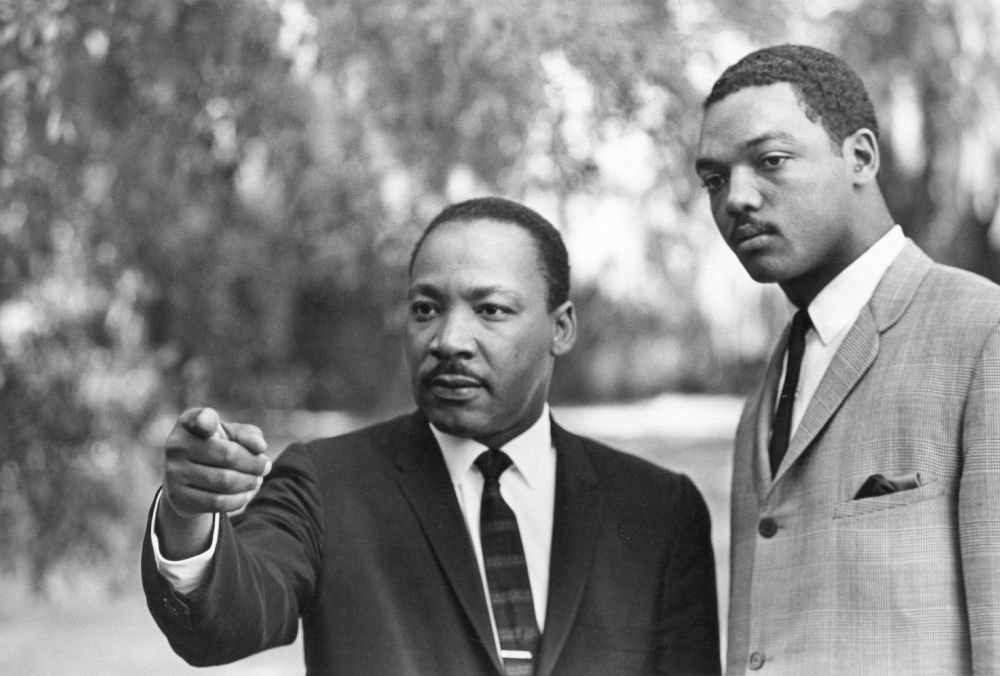
The Rev. Jesse Louis Jackson Sr., one of the most recognizable and enduring figures of the American civil rights movement, has passed away at the age of 84, closing a chapter on more than six decades of activism that reshaped national conversations about race, politics, poverty and human rights. A protégé of Dr. Martin Luther King Jr., a two-time presidential candidate and founder of the Rainbow PUSH Coalition, Jackson’s life was defined by an unyielding commitment to social justice — and by a belief that political power could be harnessed to lift those historically left behind.
His passing prompted tributes from presidents, lawmakers, clergy and activists across the political spectrum, many of whom described him as a bridge between the moral urgency of the 1960s civil rights era and the evolving demands of a diverse, multiracial democracy.
Early Life in Greenville
Born on October 8, 1941, in Greenville, South Carolina, Jesse Louis Jackson grew up in the deeply segregated American South. Raised primarily by his mother, Helen Burns, Jackson experienced firsthand the humiliations and constraints of Jim Crow. Yet he also displayed early signs of ambition and leadership. He excelled academically and athletically, eventually earning a football scholarship to the University of Illinois before transferring to North Carolina A&T State University, a historically Black college, where he became active in campus activism.
Jackson’s move into civil rights organizing came at a pivotal time. The sit-in movement was sweeping across Southern campuses, and young activists were challenging segregation in lunch counters, bus stations and public accommodations. It was in this climate that Jackson began to see ministry and activism as intertwined callings.
With Martin Luther King Jr.
In the mid-1960s, Jackson moved to Chicago and began working with the Southern Christian Leadership Conference (SCLC), the organization led by Martin Luther King Jr.. King quickly recognized Jackson’s charisma and oratorical skill, appointing him to lead Operation Breadbasket, an economic justice initiative that pressured corporations to hire Black workers and support minority-owned businesses.
Jackson was present in Memphis in April 1968 when King was assassinated. The murder of his mentor marked a turning point — both for the civil rights movement and for Jackson personally. In the years that followed, he sought to carry forward King’s vision while also charting his own course.
Building the Rainbow Coalition
In 1971, Jackson founded Operation PUSH (People United to Save Humanity), later merging it with the Rainbow Coalition to form the Rainbow PUSH Coalition. The organization aimed to unite African Americans, Latinos, labor groups, women and other marginalized communities under a broad banner of economic and political empowerment.
Jackson’s use of the term “Rainbow Coalition” emphasized solidarity across racial and class lines — a concept that would later influence progressive political movements nationwide. Through boycotts, corporate negotiations and voter registration drives, he sought to translate protest into policy.
His activism extended beyond domestic issues. Jackson frequently engaged in international diplomacy, traveling abroad to advocate for human rights, negotiate the release of American hostages and speak out against apartheid in South Africa.
Presidential Campaigns and National Influence
In 1984, Jackson made history by launching a campaign for the Democratic presidential nomination, becoming one of the first African Americans to mount a serious bid for the White House. Though he did not win, his campaign energized millions of voters and expanded the electorate. Four years later, in 1988, he ran again, winning several state primaries and caucuses and finishing second in the Democratic contest.
While he never secured the nomination, Jackson’s campaigns reshaped the party’s platform, pushing it toward stronger commitments on voting rights, economic justice and inclusion. His campaigns also paved the way for future candidates of color — including Barack Obama, whose election in 2008 marked a milestone many saw as built upon the groundwork Jackson had laid decades earlier.
Controversies and Criticism
Like many prominent public figures, Jackson’s career was not without controversy. He faced criticism for inflammatory remarks at times, and his 1984 campaign was briefly overshadowed by fallout from comments widely condemned as offensive. Jackson later apologized and sought to rebuild trust.
In the early 2000s, he also acknowledged fathering a child outside his marriage, a personal revelation that drew media scrutiny. Critics questioned aspects of his leadership style and the finances of organizations he led. Yet supporters argued that his broader legacy — of advocacy, coalition-building and moral witness — outweighed these episodes.
Throughout his career, Jackson remained a polarizing yet influential presence. He was frequently called upon to mediate during moments of racial tension, to deliver eulogies at high-profile funerals, and to rally communities during times of crisis.
Health Challenges and Later Years
In 2017, Jackson disclosed that he had been diagnosed with Parkinson’s disease, a progressive neurological disorder. Despite increasing health challenges, he continued to appear at public events, often in a wheelchair, speaking about voting rights, criminal justice reform and economic inequality.
As debates over police violence and systemic racism intensified in the 2010s and 2020s, Jackson’s voice — though physically quieter — remained symbolically powerful. Younger activists sometimes diverged from his methods but often acknowledged the path he had helped forge.
He gradually withdrew from day-to-day leadership of the Rainbow PUSH Coalition, passing responsibilities to a new generation while remaining an elder statesman of the movement.
The Final Days and National Reaction
Jackson died surrounded by family, according to a statement released by representatives of the Rainbow PUSH Coalition. Funeral arrangements are expected to include public memorial services in Chicago, where he made his home for decades, and in Washington, D.C.
Political leaders from both parties offered condolences. President Biden praised Jackson as “a conscience for the nation,” while civil rights leaders highlighted his lifelong dedication to expanding the American promise.
Clergy members across denominations recalled his sermons — delivered in a rhythmic, call-and-response style rooted in the Black church tradition — as moments that stirred both hope and urgency.
A Lasting Legacy
Jesse Jackson’s life spanned eras of profound transformation in the United States: from segregated lunch counters to the election of a Black president; from the analog age of marches and boycotts to the digital age of social media activism. He navigated each phase with a combination of moral conviction and political calculation.
Supporters credit him with helping to normalize the idea that African Americans could seek the nation’s highest office, with expanding voter participation, and with pressuring corporations and institutions to diversify their leadership ranks. Critics contend that some of his tactics were confrontational or self-promotional. Both views reflect the complexity of a figure who refused to fade quietly from public life.
At his core, Jackson described his mission as simple: to “keep hope alive,” a phrase that became synonymous with his campaigns and speeches. For millions, those words were more than a slogan — they were a call to persistent engagement in the struggle for equality.
As the nation reflects on his death, historians are likely to situate Jackson alongside the central architects of modern civil rights — not only as an heir to King’s legacy, but as a political innovator who expanded the movement’s reach into the ballot box and beyond.
In the end, the Rev. Jesse Jackson’s life was defined not by a single office held or a single march led, but by a relentless insistence that democracy must include everyone. His death marks the end of an era, but the debates and aspirations he championed continue to shape the American story.