
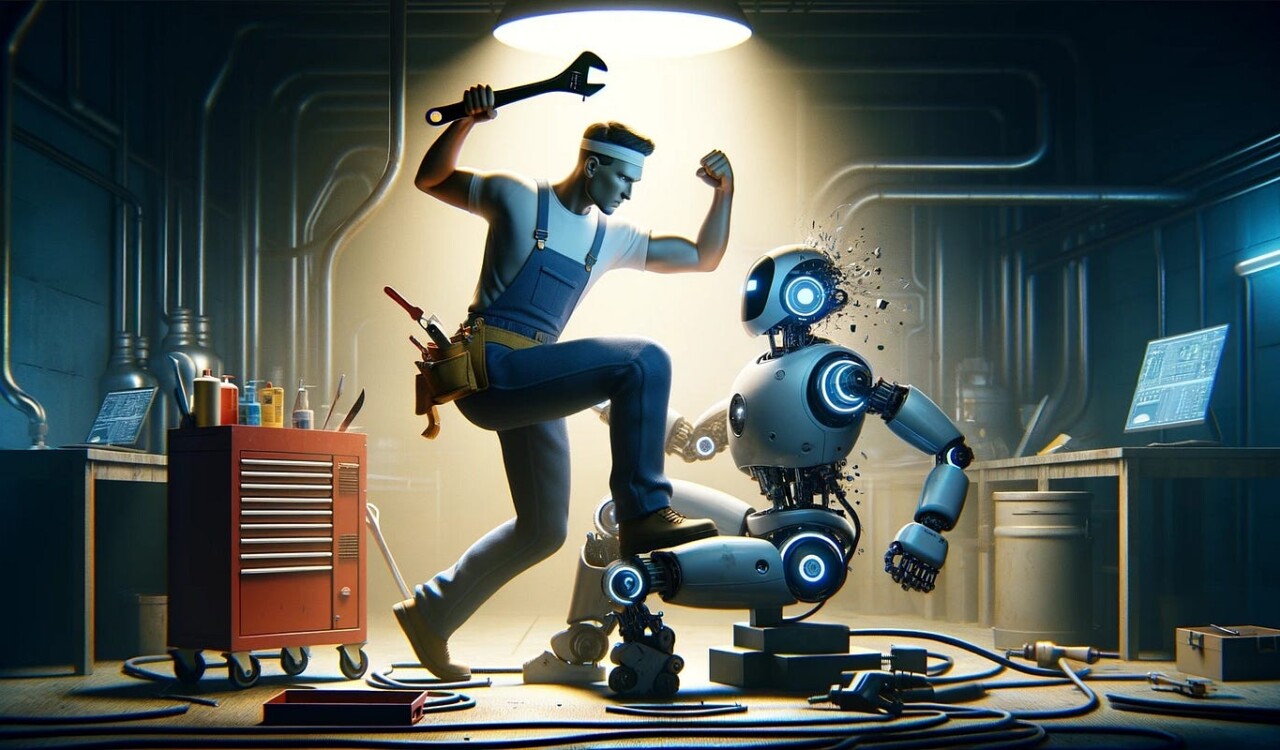
For years, a comforting narrative has circulated in conversations about automation and artificial intelligence: “AI will take white-collar jobs, not the trades. If you work with your hands, you’re safe.” Electricians, plumbers, welders, carpenters, mechanics, and construction workers are often described as insulated from the AI revolution reshaping software development, finance, law, design, and media.
There is truth in that belief — but only partially, and perhaps only temporarily.
The assumption that tradespeople are immune to AI rests on real advantages: physical complexity, unpredictability, and the embodied intelligence required for hands-on work. Yet it also contains misconceptions. AI will not affect the trades in the same way it affects office work — but it will affect them. And when it does, the impact may feel sharper and more destabilizing precisely because the sector has felt “safe” for so long.
This article explores the advantages behind the belief, the flaws in the assumption, how AI will gradually penetrate skilled trades, and why the eventual shift could hit harder than today’s white-collar disruption. It also looks at projected timelines for when AI may begin meaningfully affecting various hands-on professions.
Why People Believe Trades Are Safe From AI
The belief that trades are protected from automation is rooted in several legitimate observations.
1. Physical Dexterity Is Hard
A plumber crawling through a tight crawlspace, diagnosing a hidden leak, improvising a solution, and adapting to unexpected pipe configurations demonstrates an extraordinary level of physical intelligence. Human hands are incredibly adaptive. They combine strength, fine motor control, tactile feedback, and real-time reasoning.
Robots struggle with:
- Irregular environments
- Poor lighting
- Unpredictable obstacles
- Fine manipulation in confined spaces
- Rapid decision-making when plans change
Unlike factory floors — where automation thrives due to repetition — job sites are messy, dynamic, and unique.
2. Each Job Is Different
Trade work often involves:
- Older buildings
- Non-standard installations
- Improvised repairs
- Unforeseen complications
AI thrives on pattern recognition. When every job looks different, pattern-based automation becomes much harder.
3. Human Trust Matters
Customers invite tradespeople into their homes. They rely on:
- Communication
- Judgment
- Transparency
- Ethical decision-making
This human interaction creates perceived insulation from automation.
These realities give trades a real, but limited, buffer.
The Misconception: “Physical = Safe”
The major flaw in the immunity argument is the assumption that AI only affects cognitive or digital work. In reality, AI is not just software — it is increasingly integrated into robotics, logistics systems, diagnostics, scheduling, and supply chains.
The disruption will not arrive as a humanoid robot replacing a plumber overnight. It will arrive incrementally.
And incremental disruption can be more transformative than sudden replacement.
How AI Will Gradually Affect Trades
AI will influence trades in phases rather than through immediate job elimination.
Phase 1: Augmentation (Already Beginning)
This stage enhances human capability rather than replaces it.
Examples include:
- AI diagnostic tools for HVAC systems
- Predictive maintenance software for industrial equipment
- AI-assisted design tools in construction
- Automated scheduling and dispatch optimization
- Smart sensors detecting system failures before humans do
In this phase, workers become more productive. The result?
Fewer workers may be needed to accomplish the same amount of work.
The disruption here is subtle. It does not eliminate trades — it increases efficiency.
Phase 2: Task Automation (Next 5–15 Years)
Rather than replacing entire jobs, AI will automate specific tasks:
- Automated drywall finishing robots
- Brick-laying machines
- AI-guided welding systems
- Robotic demolition systems
- Autonomous heavy equipment
Some of these technologies already exist in limited forms. What holds them back is cost, reliability, and environmental variability — not theoretical capability.
As hardware improves and costs drop, companies may find it economically advantageous to deploy semi-autonomous machines for repetitive physical tasks.
The trades may not disappear — but entry-level positions could shrink.
Phase 3: Integrated Robotics + AI (15–30+ Years)
The true shift occurs when AI reasoning systems integrate seamlessly with robotics.
Imagine:
- A robotic electrician diagnosing wiring faults in a commercial building
- Autonomous construction crews performing framing and roofing
- AI-driven plumbing bots capable of navigating pipe systems
We are not there yet. But technological progress in robotics, computer vision, and embodied AI suggests that these developments are plausible — especially in structured environments like new construction.
The timeline is uncertain, but unlikely to be immediate.
Why the Impact Could Hit Harder Than Current AI Disruption
Today, AI is affecting:
- Writers
- Designers
- Coders
- Marketers
- Analysts
- Customer support roles
These workers often operate in digital spaces where AI scales instantly. But many in trades have watched this shift from a distance, feeling secure.
That psychological buffer creates risk.
When a group believes it is immune, it prepares less.
The impact on trades could feel harsher because:
1. Cultural Identity Is Stronger
Trade professions are often tied to identity, family lineage, and pride in craftsmanship. The narrative of “real work” — physical, skilled, hands-on — stands in contrast to “desk jobs.”
If AI penetrates these fields, it challenges more than income. It challenges identity.
2. Training Pathways Are Slower to Adapt
Apprenticeships and trade education are built around long-standing skill models. If automation reshapes those skill demands, retraining may lag behind.
3. Capital Concentration
Advanced AI-enabled robotics require capital investment. Large firms will adopt first. Smaller independent contractors may struggle to compete with automated competitors offering lower costs and faster turnaround.
This could accelerate consolidation in industries that historically allowed small operators to thrive.
The Stark Reality Scenario
The most disruptive scenario is not full replacement — it is workforce compression.
Imagine:
- A construction project that once required 50 workers now requires 30 due to robotics.
- A plumbing company that once needed 10 technicians now needs 6, supported by AI diagnostics.
- A welding operation reduced by half due to robotic precision systems.
Jobs do not vanish overnight. They gradually thin.
Wages may stagnate.
Opportunities narrow.
Competition increases.
The impact may not resemble sudden mass unemployment. It may resemble slow structural contraction.
That kind of disruption can be more destabilizing because it unfolds quietly.
Why We Are Still “Many Years Away”
Despite the warning signs, it is important not to exaggerate immediacy.
Several factors slow down AI’s impact on trades:
1. Physical World Complexity
Real-world environments are chaotic. AI systems perform far better in digital spaces than unpredictable physical ones.
2. Cost of Robotics
Building and maintaining physical automation is expensive. For many small and medium-sized projects, human labor remains more flexible and cost-effective.
3. Liability and Regulation
Construction, plumbing, and electrical work carry safety risks. Regulatory frameworks move slowly and may delay widespread robotic adoption.
4. Demographic Labor Shortages
Many countries already face shortages in skilled trades. In the short term, AI may supplement rather than replace workers.
Because of these factors, widespread adverse effects across most trades are likely 10–25 years away, varying by specialty.
Projected Impact Timelines (Broad Estimates)
These are speculative but grounded in current technological trends:
Next 5–10 Years
- Increased AI diagnostics
- More scheduling and logistics automation
- Limited task-specific robots in commercial settings
- Productivity increases, modest workforce pressure
10–20 Years
- Greater adoption of semi-autonomous heavy equipment
- Robotic systems in new construction
- Reduced demand for some repetitive manual tasks
- Noticeable workforce compression in certain sectors
20–30+ Years
- Advanced embodied AI capable of handling more complex physical environments
- Potential transformation of large-scale construction and industrial maintenance
- More significant employment restructuring
However, high-variability residential trades may resist full automation longer than structured industrial environments.
The Double-Edged Sword: Opportunity and Risk
It is critical to understand that AI will not simply “destroy” the trades. It will also create new opportunities:
- Robotics maintenance specialists
- AI-enhanced construction managers
- Smart infrastructure technicians
- Hybrid digital-physical system installers
- Advanced equipment operators
Those who adapt early may benefit.
Those who assume immunity may struggle.
The Core Misconception
The misconception is not that trades are safe today.
The misconception is believing they are safe forever.
AI does not replace professions in a single leap. It infiltrates systems — diagnostics, logistics, planning, optimization — and gradually reshapes labor demand.
The current wave of AI is heavily digital. The next wave will increasingly merge digital intelligence with physical capability.
When that convergence accelerates, the sense of security in hands-on fields may erode quickly.
Conclusion: Preparation Over Complacency
The narrative that “AI won’t affect people who work with their hands” is both understandable and incomplete.
Yes, trades are more resilient than many white-collar roles in the short term.
Yes, full robotic replacement is likely decades away in most sectors.
Yes, the physical world remains a major barrier.
But gradual transformation is already underway.
The impact on trades will likely come later — and when it does, it may feel more abrupt precisely because it was assumed impossible.
The wisest stance is neither panic nor denial.
It is preparation.
Workers in trades who:
- Embrace technology
- Learn hybrid digital skills
- Understand AI-assisted tools
- Stay adaptable
will likely thrive.
Those who rely on permanence may face a stark awakening when efficiency, automation, and capital investment quietly reshape their industries.
AI will not ignore the trades.
It will reach them differently.
And when it does, the shock may not be explosive — but it could be profound.