
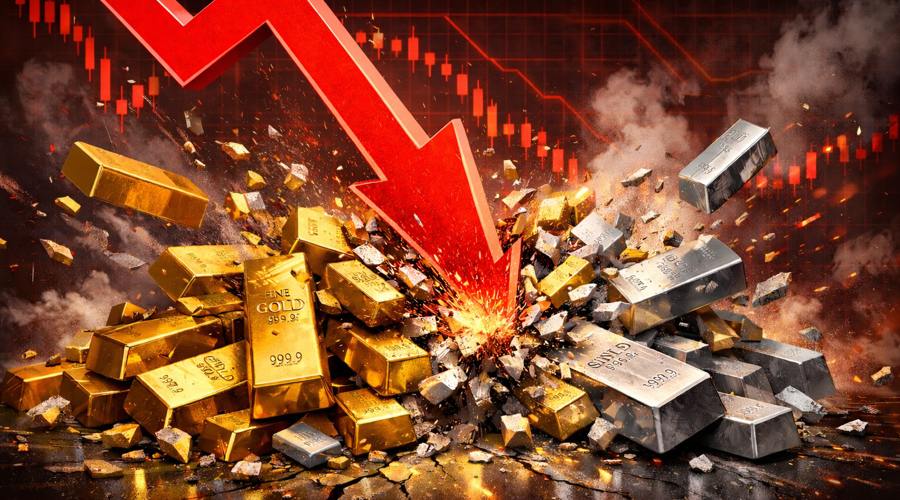
In late January 2026, global markets saw one of the most dramatic price moves in precious metals history. After a powerful rally that saw both gold and silver reach records — silver above $115 and gold above $5,000 per ounce — prices suddenly crashed sharply on Western exchanges, wiping out significant gains.
This move shocked many investors because the downturn in paper markets was not accompanied by a corresponding collapse in the physical markets, particularly in Asia — and especially on the Shanghai Gold Exchange (SGE) for physical silver and gold.
Understanding this disparity requires looking at two fundamentally different markets driving price action: the paper market dominated by futures and derivatives, and the physical market driven by actual delivery of bullion. What happened in January 2026 highlights how detached these two markets can be.
1. The Mechanics of the January Crash
The sharp drop in paper prices — particularly for silver — was most visible on Western exchanges like COMEX and futures platforms. Within a short period, silver prices plunged more than 30 % intraday, while gold also fell significantly.
Several forces contributed:
• Margin Hikes and Forced Liquidations
In late 2025, CME Group raised margin requirements for silver futures contracts. This meant traders needed more capital to hold positions. Long holders who were leveraged were forced to liquidate to meet these new requirements, driving prices down in a cascade of sell orders.
• Technical Liquidations and Volatility
Algorithmic trading amplified moves. Mass liquidation orders triggered stop-losses that deepened the downturn. Some market analysts described Jan 30 as a “flash crash” in silver futures because trading was dominated by derivatives activity rather than any actual selling of metal.
• Macro Triggers
News such as the U.S. Federal Reserve chair nomination and a strengthening dollar added pressure on dollar-denominated commodities like gold and silver.
However, crucially, most of this pressure occurred in paper markets — not because physical supply or demand suddenly evaporated.
2. Shanghai & Physical Markets Defied the Crash
Across Asia, particularly on the Shanghai Gold Exchange (for gold and silver) and related physical pricing mechanisms, the price behavior told a very different story.
While paper prices plunged in the West, physical silver prices in Shanghai remained unusually high, sometimes over $120–$130 per ounce, significantly above Western prices during the same period.
This divergence — sometimes exceeding 40 % between physical Shanghai prices and COMEX futures — is historically extraordinary and highlights a fundamental market imbalance.
Why Shanghai Stayed Strong
- Actual Physical Demand: Chinese industrial demand — for electronics, solar panels, and EV production — continued unabated, requiring real metal rather than paper contracts.
- Inventory Declines: Physical inventories on the Shanghai Futures Exchange showed substantive drawdowns, suggesting strong real withdrawal activity.
- Export Restrictions & Supply Limits: China implemented export controls and licensing regimes for refined silver in 2026, tightening the global availability of deliverable metal and reducing exports that could arbitrage price gaps.
- Physical markets price metal by real demand and delivery — what industrial buyers and investors are actually paying for metal they can take delivery of. That’s why Shanghai prices were largely unaffected by Western paper squeezes — the fundamentals have not changed.
3. The Two Silver Markets: Physical vs. Paper
To many observers, the events of January 2026 exposed a long-standing but often overlooked truth: there are essentially two silver markets.
• Physical Silver Market
This consists of real bullion — bars, coins, and exchange-deliverable metal. Buyers in this market are seeking tangible metal they can hold or use. Most Asian markets, especially Shanghai and other physical price benchmarks, reflect real supply and demand for metal that physically changes hands.
In these markets:
- Prices reflect actual delivery costs.
- Inventory data matter.
- Premiums can be far above Western quoted spot if supply tightens.
• Paper Silver Market
This includes:
- Futures contracts
- Options
- ETFs
- CFDs and other derivatives
These instruments represent claims or bets on price, not necessarily on physical delivery. The paper market usually dwarfs the physical market in both volume and notional value.
For silver, the paper-to-physical ratio has been estimated at hundreds of paper claims for each physical ounce — sometimes cited at over 350:1.
In other words: for every one ounce of physical silver, there are hundreds of paper claims on it. This structural imbalance means the paper market can swing prices independently of physical supply.
4. Why the Paper Market Drove Down Prices
The January crash largely unfolded in the paper market because:
• Leverage Was High
Many traders in silver futures and paper products were highly leveraged. Margin hikes forced them to sell into a falling market, accentuating the downturn.
• Forced Liquidations
When leveraged accounts are squeezed, positions are sold at market, regardless of fundamentals. This liquidation pressurecan overwhelm the market even when physical demand remains strong.
• Disconnect From Physical Supply
Paper markets trade based on expectations and positions, not necessarily on metal held in vaults. Hence, while declarative prices collapsed on Western exchanges, no equivalent physical selling occurred in many physical markets. Shanghai physical prices did not crash alongside the paper price.
This illustrates that paper markets can drive price moves that do not reflect reality in physical supply and demand.
5. The Physical Shortage — What Happens if Everyone Wants Metal
A major concern among market watchers in early 2026 is that there isn’t enough physical silver to satisfy all paper contracts if holders demand delivery.
Data referenced by traders show that:
- COMEX registered inventory covers only a small fraction of open futures contract obligations — sometimes as low as ~14 % or lower relative to open interest.
Translation:
If a significant number of paper contract holders suddenly demanded physical delivery, there wouldn’t be enough physical metal in exchange-approved vaults to meet those demands. This isn’t speculative — it’s arithmetic based on reported vault inventories versus open contract obligations.
This gap highlights a structural fragility:
- The paper market can create thousands of claims on an ounce that doesn’t exist physically.
- Most contracts settle in cash because delivery is impractical or unavailable.
- As long as most holders don’t ask for physical metal, the system persists.
But if confidence erodes or delivery demands rise, the paper price could have to move toward the physical price — and that could be a major shock.
6. What the 2026 Crash Tells Us About Market Structure
The events of late January highlight three key realities:
A. Paper Markets Are Volatile and Liquid — But Not Always Real
Price swings can be exacerbated by trading flows, leverage, and institutional dynamics that have little to do with physical supply. This is especially true in silver, where paper claims far outnumber real metal.
B. Physical Markets Reflect Real Supply and Demand
In Shanghai and other physical hubs, prices remained strong during the paper crash — showing real demand for metal that matters for industry and long-term investment.
C. Structural Imbalances Can Create Divergences
The historic gap between Western paper prices and Asian physical prices suggests that price discovery may be shiftingand that the market’s plumbing — physical inventories versus derivatives — matters.
Conclusion: A Cautionary Market Moment
The late January 2026 gold and silver crash was not simply a selloff — it was a shock to how markets balance paper contracts against real, deliverable metal. Western exchanges saw dramatic price moves fueled by leverage, margin adjustments, and derivative flows. At the same time, Shanghai’s physical markets held firm, priced based on real supply and demand, and even posted significant premiums over Western prices.
This isn’t just semantics — it’s structural.The silver market, in particular, appears to be showing a decoupling between paper pricing and physical reality. With physical inventories far smaller than paper claims, the system relies on most participants continuing to accept cash settlement or roll contracts rather than seeking physical delivery.
For investors and market watchers, this episode is a reminder: paper market prices don’t always tell the full story — especially in commodities with real physical constraints.